


15May
Eight elephants died because a warning failed to reach the train in time. DAS technology can prevent such tragedies through real-time automated wildlife detection
In the fog of a December night in Assam, the Rajdhani Express struck a herd of elephants — 30 minutes after forest guards had already raised the alarm. The technology to prevent it exists. It wasn't there.
Incident Timeline

What Happened That Night
At approximately 2 AM on December 20, 2025, the Rajdhani Express was moving through fog-covered forests in Nagaon district, Assam. Visibility was near zero. The train did not slow down. By the time the loco pilot spotted movement on the tracks and applied the emergency brakes, it was too late.
The train struck a herd of elephants head-on — killing eight on the spot: three adults and five calves. A newborn calf, delivered at the moment of collision due to the trauma inflicted on its mother, also died there in the dark. Five coaches of the Rajdhani Express derailed.
What makes this harder to bear is one damning fact: forest guards had radioed the station master at 1:30 AM — a full 30 minutes before the collision — warning that elephants were near the tracks. The train was never stopped. The warning was never relayed to the loco pilot. Human coordination failed completely, and eight animals paid with their lives.
This is not isolated. Between 2019 and 2026, over 94 elephants died on Indian railway tracks — most in Assam, West Bengal, and Odisha, where forested terrain, darkness, and nocturnal elephant movement create the deadliest conditions. Every measure so far — speed limits, cameras, forest patrols — depends on the human communication chain holding at 2 in the morning, in dense fog, in a remote district. At Nagaon, it didn't hold.
The Technology That Could Have Prevented This
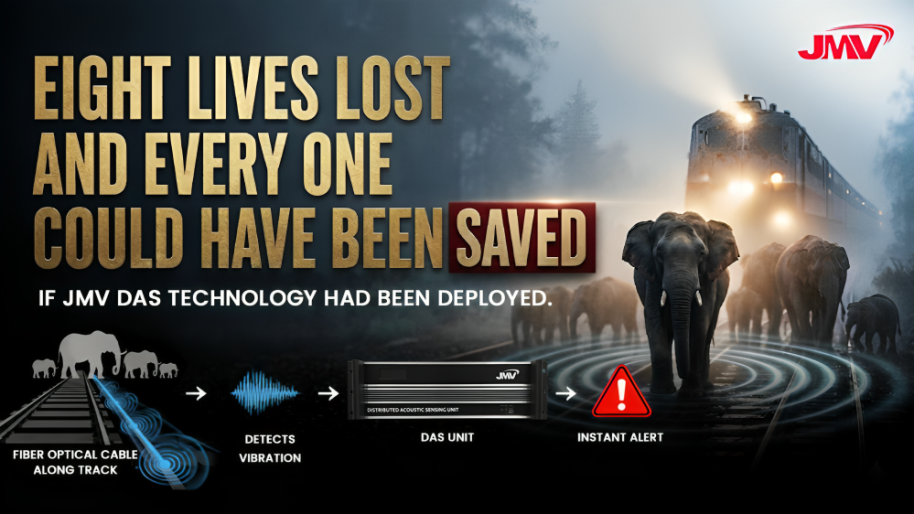
The solution already exists, is manufactured in India, and is deployable today. Distributed Acoustic Sensing — DAS — removes the human relay entirely from the equation. Fiber optic cables laid alongside the tracks act as one continuous sensor. A laser pulse sent down the fiber detects any physical disturbance near it — the footfall of a herd, vibrations from approaching animals — by measuring changes in the returning backscattered light.
The system pinpoints the exact location of the disturbance, accurate to within a few meters, and fires an automated alert simultaneously to the loco pilot's cab and the control room. No camera. No phone call. No station master in the loop. The alert travels at the speed of light — not at the pace of a sleepy communication chain at 2 AM.
"No cameras to blind in fog. No batteries to die in the monsoon. No human relay to break at 2 AM. The fiber watches every meter of track, every second of every night — in any weather, in complete darkness."
How DAS Works

Step-by-Step: From Footfall to Alert
- Fiber Deployment - Fiber optic cables run alongside the railway tracks. In many corridors, existing telecom fiber already serves this purpose — no new cabling required.
- Laser Pulse Emission - A DAS unit fires laser pulses continuously down the fiber, establishing a real-time acoustic baseline for the entire monitored length.
- Vibration Detection - An approaching elephant herd creates ground vibrations that alter the backscattered light returning to the DAS unit in a measurable, classifiable pattern.
- Event Classification - Advanced algorithms identify the event type — elephant herd, human intruder, or vehicle — and calculate its precise location along the track within meters.
- Automated Alert - An instant alert reaches the loco pilot's in-cabin display and the central control room simultaneously. No human relay required. Response time: seconds.
Why Human Systems Fail — and DAS Does Not

The Case for Action
JMV LPS Limited, an Indian OEM based in Noida, has already built a fully indigenous DAS system — hardware, fiber, and software, all made in India — with elephant and tiger detection explicitly documented as a railway application. This is not a prototype. It is production-ready and deployable today. Notably, JMV LPS holds over 80% of Indian Railways’ projects for Optical Fiber-based Intrusion Detection — making it not just the most capable, but the most trusted and proven partner already embedded within the railway ecosystem.
The argument against rapid deployment is almost always cost. But five derailed Rajdhani coaches alone runs to crores in damage and compensation — against which DAS installation across high-risk wildlife corridors becomes not just the right thing to do, but the economically rational choice. In corridors where telecom fiber already runs alongside the track, the incremental cost is only the sensing unit and software integration.
Eight elephants died on December 20, 2025, because a 30-minute warning was received and not acted upon. That is a human failure. The fix — already built, already tested, already sitting in a factory in Noida — is not.
The only remaining question is whether Indian Railways installs it before the next herd crosses the next fog-covered track, or after.
How Many More Before We Act?
The technology exists. It is made in India. It is deployable today. The question is no longer whether we can protect our elephants — it is whether we will choose to.


.png)


.png)
.png)
.png)


