


06July
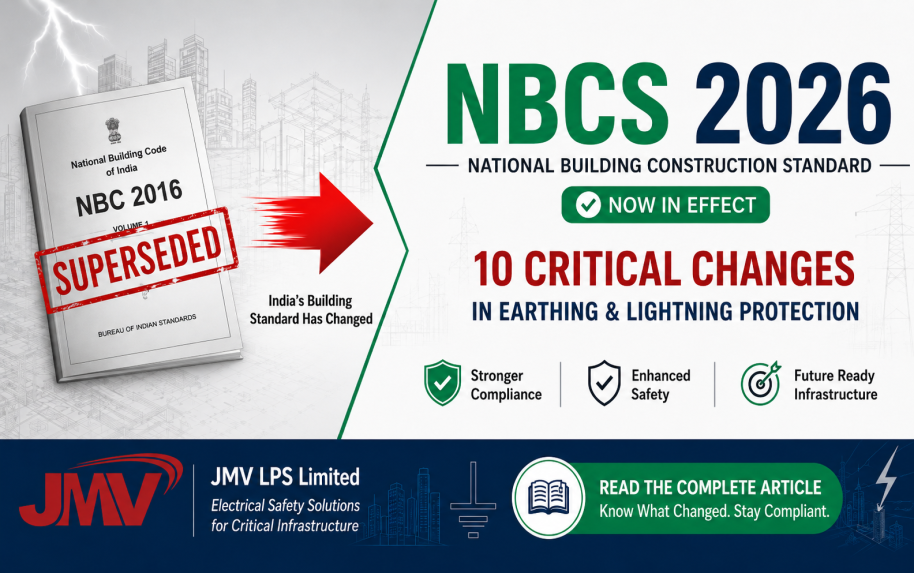
India's building regulations have entered a new era with the introduction of NBCS2026 (National Building Construction Standard).
NBC 2016 vs NBCS 2026 — What Changed and What You Need to Do
India's Building Code Has a New Name — and New Rules
If you're an electrical consultant, project manager, or contractor working on construction projects in India, there's something you need to know: the National Building Code (NBC) 2016 has been officially superseded.
Its replacement isn't called NBC 2026. It's called NBCS 2026 — the National Building Construction Standard, published as SP 7:2026 by the Bureau of Indian Standards (BIS).
The change from "Code" to "Construction Standard" isn't just semantic. It reflects a fundamental shift in how India's building regulations are structured, aligning with BIS's standards framework and moving towards a more enforceable compliance model.
This article provides a complete comparison of NBC 2016 and NBCS 2026, focusing on the earthing and lightning protection sections (Part D, Section 2) that have seen the most significant changes.
Why the Name Changed: From "Code" to "Construction Standard"
Under the BIS framework, a "code" is a practice guideline, while a "standard" carries stronger normative weight. The renaming of NBC to NBCS signals that the document is moving from a voluntary reference to a specification with clearer compliance expectations.
For practising engineers, this means that references to "NBC 2016" in project specifications, tender documents, and design reports should be updated to "NBCS 2026" or "SP 7:2026." Continuing to reference the superseded document creates a compliance gap — not immediately dangerous, but professionally and contractually significant.
What's New in NBCS 2026: 10 Key Changes in Earthing and Lightning Protection
The earthing and lightning protection sections of NBCS 2026 contain 10 new or updated clauses compared to NBC 2016. Here's what changed:
1. Clause 8.2.13 — Online Earth Monitoring System (NEW)
NBC 2016 had no provision for continuous earthing monitoring. NBCS 2026 recommends online earth monitoring systems with real-time resistance and integrity measurement for buildings with sensitive electronic systems. Force level: recommended ("can be considered").
2. Clause 8.2.17 — Exothermic Welding (NEW MANDATORY)
This is the most significant change. NBC 2016 had no standalone clause on exothermic welding. NBCS 2026 introduces a dedicated requirement: critical connections below ground or exposed to moisture SHALL be made using exothermic welding. Force level: mandatory ("shall"). This is not a recommendation — it's a compliance requirement for the specified connections.
3. Clause 8.2.24 — Isolated Earthing Safety / Isolating Spark Gaps (NEW MANDATORY)
NBC 2016 did not address isolated earthing hazards as a standalone provision. NBCS 2026 declares isolated earthing unsafe during transient conditions and mandates earth couplers or isolating spark gaps if isolated earthing is used. Force level: mandatory ("shall") when isolated earthing is present.
4. Clause 10.1.2 — Fibre to the Home / FTTH (ENTIRELY NEW)
A completely new clause addressing FTTH infrastructure in buildings — fibre optic technology, ONT, splitters, and integration with building services. NBC 2016 had no FTTH provisions.
5. Clause 10.x — Data Centres (NEW)
Dedicated provisions for data centre environments covering enhanced earthing, power quality, redundancy, and UPS requirements for critical IT loads. NBC 2016 did not address data centres as a separate category.
6. Clause 10.x — Buildings Exceeding 24 Storeys (NEW)
New requirements for ultra-high-rise construction: enhanced earthing, busduct systems for vertical power distribution, and fire-rated wiring. NBC 2016 did not separately address buildings above 24 storeys.
7. Clause 11.6.1.5 — LPS for Rooftop Solar PV (NEW DESIGN GUIDANCE)
A dedicated sub-clause providing rolling sphere method design guidance for solar PV lightning protection. Includes specific examples (1m rod at 0.5m height covering approximately 12m × 9m) and step potential reduction via earth mats and isolating spark gaps. NBC 2016 had no dedicated solar PV LPS design methodology.
8. Clause 11.6.1.6 — LPS for Telecom Towers (NEW)
New dedicated provisions: tower acts as air-termination, two separate 150 mm² down-conductors mandatory, 28 mm² minimum dielectric cable specified, and SPD protection required for every cable between tower and building.
9. Clause 11.6.1.7 — LPS for Car Parks and Helipads (NEW)
Air-termination studs for multi-storey car park roofs and helipads, with mesh width specifications per protection class (Class I: 5×5m through Class IV: 20×20m).
10. Clause 11.7.4.10 — SPD for Outdoor Equipment (UPDATED)
This existed generally in NBC 2016 but NBCS 2026 adds an explicit enumerated list: CCTV cameras, LED street lights, weighbridges, firefighting systems, and rooftop solar PV installations. The explicit listing removes ambiguity about which equipment requires SPD protection.
Understanding Force Levels: SHALL vs SHOULD vs MAY
One of the most important distinctions in NBCS 2026 is the force level of each provision:
SHALL = mandatory. The standard requires it. Non-compliance means your project doesn't meet the code.
SHOULD = recommended. Best practice, strongly advised, but not strictly enforced.
MAY = permissible. An option you can adopt, particularly for premium or critical projects.
In the context of NBCS 2026 earthing and LPS changes, the SHALL provisions are: exothermic welding for critical buried connections (Clause 8.2.17), isolating spark gaps when isolated earthing is used (Clause 8.2.24), 150 mm² down-conductors for telecom towers (Clause 11.6.1.6), and SPD for all cables between telecom towers and buildings.
What Should You Do Now?
If you're a consultant: review all current project specifications. Any reference to "NBC 2016" should be updated to "NBCS 2026" or "SP 7:2026." Check whether your earthing designs comply with the new SHALL mandates, particularly for buried connections and isolated earthing.
Frequently Asked Questions:
Is NBC 2016 still valid, or must I use NBCS 2026 now?
NBC 2016 has been officially superseded at the central level by NBCS 2026 (SP 7:2026), following the Bureau of Indian Standards' gazette notification dated 30 April 2026. For new specifications, tenders, and design reports, reference NBCS 2026 or "SP 7:2026" going forward. Some state and municipal building bye-laws may take time to formally update their cross-references, so it's worth checking the local authority's current adoption status for your specific jurisdiction.
When did NBCS 2026 come into effect?
NBCS 2026 was notified by the Bureau of Indian Standards on 30 April 2026, officially superseding NBC 2016 as India's national building construction standard.
Is NBCS 2026 mandatory, or is it a voluntary guideline?
It depends on the clause and the adopting authority. Within NBCS 2026 itself, each provision carries its own force level: SHALL (mandatory), SHOULD (recommended), or MAY (permissible). For the earthing and lightning protection sections, several clauses are SHALL requirements, including exothermic welding for critical buried connections (8.2.17) and isolating spark gaps where isolated earthing is used (8.2.24). Full legal enforceability also depends on individual state and municipal authorities incorporating NBCS 2026 into their local building bye-laws, so specifiers should track both the standard's force level and local adoption status.
What is the difference between NBC 2016 and NBCS 2026 for earthing and lightning protection?
NBCS 2026 adds 10 new or updated clauses to the earthing and lightning protection sections (Part D, Section 2) that did not exist, or existed only in general form, under NBC 2016. These cover online earth monitoring, exothermic welding, isolated earthing safety, and dedicated lightning protection design guidance for solar PV, telecom towers, and car parks/helipads, among others.
Which earthing and lightning protection clauses in NBCS 2026 are mandatory ("SHALL")?
The SHALL provisions are: exothermic welding for critical buried or moisture-exposed connections (Clause 8.2.17), isolating spark gaps or earth couplers wherever isolated earthing is used (Clause 8.2.24), 150 mm² down-conductors for telecom towers (Clause 11.6.1.6), and SPD protection on every cable between a telecom tower and its building.
Is exothermic welding mandatory for earthing connections under NBCS 2026?
Yes, for a specific case. Clause 8.2.17 makes exothermic welding mandatory for critical earthing connections that are below ground or exposed to moisture. NBC 2016 had no standalone clause on this.
What is an isolating spark gap, and when does NBCS 2026 require one?
Clause 8.2.24 treats isolated earthing as unsafe during transient conditions and mandates earth couplers or isolating spark gaps wherever isolated earthing is used. This was not addressed as a standalone provision under NBC 2016.
Do existing buildings need to upgrade their earthing systems to comply with NBCS 2026?
No. Buildings already designed to NBC 2016 don't need retroactive upgrades. However, any new modifications, extensions, or major maintenance on those buildings should reference NBCS 2026.


.png)


.png)
.png)
.png)


